Monday, November 24, 2008
Google Earth article
I'm kind of a Google Earth junkie. I think it's fascinating to zoom in on remote cities around the world (not to mention my own backyard; gee my forsythias look healthy). But Google Earth isn't just for armchair travelers; you can use Google Earth as a trip-planning tool. Check out the article I wrote on the subject, which appeared in the travel section of yesterday's edition of The Boston Globe.


Tuesday, November 18, 2008
The Heisman and the Hail Mary
 Boston College recently unveiled a new statue that honors one of the Catholic school's "patron saints": Doug Flutie. The statue, outside Gate D of Alumni Stadium, immortalizes the singular moment that defined Flutie's career: the "Hail Mary" pass against Miami in 1984. The bronzed quarterback's right hand grips the football as he plants all his weight on his right leg. His arm is reared back as far as possible as he looks up to the heavens for some divine intervention as he gets ready to hurl the football with all his might like Zeus hurling a lightning bolt. This being a Jesuit college, we can say that the prayer was answered as the ball fell into the arms of Gerard Phelan to win the game. On the base of the statue is the radio play by play, which loses a bit of its luster being read rather than heard: "Touchdown! Touchdown! Touchdown! Touchdown, Boston College! He did it! He did it! Flutie did it!"
 If you want to relive the moment even more, check out the Hajjar Family Football Museum in the adjacent Yawkey Athletics Center. Inside, you can go to the video screen and watch the Hail Mary play and other great moments in BC football history (the grainy black and white film from the undefeated 1940 season is great). Display cases include individual and team trophies and memorabilia from the college's football programs. Also on display are the bowl game trophies won by the team. You'll notice the elaborate Diamond Walnut San Francisco Bowl and Carquest Bowl trophies dwarf those of the simple Sugar Bowl and Cotton Bowl trophies proving that the garishness of bowl trophies is inversely proportional to its importance.

The highlight, though, is Flutie's Heisman Trophy, which greets you as soon as you enter the museum. The trophy may be the most iconic in American sport with its throwback leatherhead clutching the ball under his left arm as he gets ready to deliver a textbook stiff-arm with his right. Even though he's barely more than a foot tall, the trophy, which was awarded to Boston College along with another one for Flutie himself, still looks like he can punch a wallop.
Friday, November 7, 2008
Huntington Avenue Grounds and South End Grounds
 Now that the baseball season is over and the Hot Stove League is warming up, you may find yourself in need of a hardball fix sometime in the next few months before pitchers and catchers report to Fort Myers. If so, head over to the campus of Northeastern University.
 If you get off the Green Line's E branch at the Northeastern stop and cross Huntington Avenue and wander behind the Cabot Center, you'll come across a small courtyard area that feels like a typical college quad with its trees, benches, and flanking collegiate buildings. Inside the quad, you'll find a singularly focused man. He's crouched over, fiercely staring straight ahead at something. He's unflinching; not even the constant stream of co-eds that hustle and bustle by on their way to class can avert his laser-like gaze. No matter what time of day, what time of year, the bronze figure of Cy Young is always in that crouch, five-fingered glove on his left knee, waiting for the catcher to flash him a sign to deliver his next pitch.

The statue of Cy Young, the gold standard when it comes to major league hurlers, stands on what used to be the mound of the Huntington Avenue Grounds, home to Boston's American League franchise before they moved about a mile away to Fenway Park. The Huntington Avenue Grounds are notable not only for being the first home of the Red Sox, but for being the site of the first World Series in 1903. Boston defeated Pittsburgh in eight games (it was best of nine at the time) to capture the inaugural fall classic and usher in baseball's "modern era." From the ballpark's mound, Cy Young spun some of his record 511 wins and pitched baseball's first perfect game of the twentieth century on May 5, 1904.

Embedded in the ground sixty feet away from Cy Young is a granite marker shaped like home plate that commemorates the first World Series. That marker is laid at the spot where batters dug in at the ballpark. Imagine what they must have felt looking out at Cy's steely gaze and digging in for the next pitch from the flamethrower.
Back on the Huntington Avenue side of the Cabot Center, you'll find a small plaque that commemorates the Huntington Avenue Grounds and the 1903 World Series. The plaque is located approximately on what was then the left-field foul line. The left-field fence ran along the Huntington Avenue sidewalk.
Inside the Cabot Center is a display case on the second floor, next to the entrance to the basketball court, that houses a very small collection of artifacts related to the old ballyard, including old photographs and replica wool jerseys. You'll need to check in at the front desk to get into the gym, but the collection is pretty small and sports fans might actually be more interested in the adjoining display cases that honor some of the greats of Northeastern athletics.
While the Red Sox were playing at the Huntington Avenue Grounds, Boston's National League franchise was playing just a tape-measure shot away at the old South End Grounds. The ballpark was first home to the first professional team and the first baseball dynasty, the Red Stockings, who won four of five National Association pennants between 1871 and 1875. Over the years, the team's name would evolve until it became the Braves, who played at the South End Grounds until 1914. Between 1888 and 1894, the ballpark featured a grand pavilion that looked like a fairytale castle with its medieval-style turrets. Unfortunately, the grandstand was destroyed by the Great Roxbury Fire of 1894, which started in the right-field bleachers during the game.

Today, the Ruggles T station stands on the site of the South End Grounds. It's just a short walk from the Cy Young statue. Go down Forsyth Street, go up into the station, and just past the turnstiles for the Orange Line is a small green marker on the left-hand side. The marker, erected by The Bostonian Society, is the only sign connected to the old ballyard.
More on these two ballparks will be included in the forthcoming book, The Die-Hard Sports Fan's Guide to Boston.
Tuesday, October 28, 2008
Northeast Boating Book Review
There's a great review of Discovering the Boston Harbor Islands in the November 2008 edition of Northeast Boating Magazine. Check it out.
Monday, October 27, 2008
Witchcraft Sites in Danvers
Halloween's right around the corner, and while Salem gets all the headlines--and the tourists--because of it's association with the witch trials of 1692, the whole hysteria actually began in Salem Village (which today is Danvers). So if you want to escape the crowds, and find some authentic witchcraft-era historical sites, head to Danvers. Check out the article I wrote for yesterday's travel section of The Boston Globe for more information.
On another note related to the Globe, I'm going to be a regular contributor to the Globe's travel blog, Globe-trotting. Most of my posts are going to be on sports travel, and my first post is about the tours of Yankee Stadium that are still being offered even though the pinstripers' season has been done for quite some time.
Thursday, October 23, 2008
Suffolk Downs
 Given the state of the economy, one of the safest investment choices might be to put your hard-earned money into the ponies. If you want to take your chances at the racetrack and put a few sawbucks down on the horses, head to Suffolk Downs. And even if you're not a gambler, Boston sports fans will be hard-pressed to beat the $2 admission price for a day at the races.
Suffolk Downs first opened its doors in 1935, right in the midst of the Great Depression. Horse racing was hugely popular back then, but these days the track is more sparsely populated. (Although if attendance trends at the track are inversely related to the Dow Jones average, get ready for an equine renaissance.) Horse racing may still be the sport of kings, but the crowd at Suffolk Downs is decidedly proletariat. The dress code is certainly not on par with Kentucky Derby day at Churchill Downs; you'll find more windbreakers than fancy hats.

If you do want to bet on the races, buy a track program to get all the information you need (split times, prior results, handicapper picks, etc.) to make an educated bet or, just go ahead and bet on that horse with the name you like and use the program as a prop to slap on your thigh as you urge on your steed as he lumbers down the stretch to a last-place finish. You can also tear out a list of entries and starting odds from the morning paper and bring it with you if you don't want to spring for the program. (Bring a pair of binoculars to so you can watch the horses on the back stretch.)
You can place your bets at any of the betting windows or you can use one of the self-service betting machines. Under state law, there are no ATMs inside Suffolk Downs, so it's kind of a change to be able to put your money into a machine but not be able to take any money out of one.

Inside the grandstand of Suffolk Downs, banners with racing silks of famous horses hang like retired numbers from the rafters. It's a neat historical touch, and outside of the clubhouse entrance is a small monument to Seabiscuit, that famous racer from the 1930s who was discovered by trainer Tom Smith at Suffolk Downs in 1936. Next to the monument is a statue of Seabiscuit's jockey Red Pollard that looks like one of those old lawn jockeys.
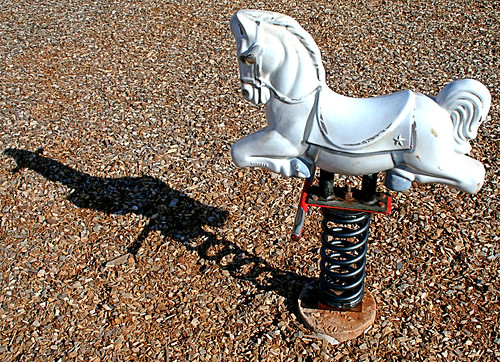
Suffolk Downs has an enclosed, indoor grandstand and plenty of benches and picnic tables outside as well. If you have kids, there is a small playground outside (which remarkably doesn't have any toy ponies to ride) that is well away from the standing area where many of the cigar- and cigarette-smoking patrons come out to watch the races. If you're hungry, there are concession stands on the first floor, and there is a sports bar on the second floor along with the Terrace restaurant, which has seats that sort of look like the Green Monster seats with their tiers of rows looking out on the track. The Terrace serves entrees, sandwiches, burgers.

Suffolk Downs has simulcast racing so you can bet on the action on other tracks throughout the country. There is a teletheater on the second floor that has a bank of big-screen televisions and there are small televisions at each seat. Most seats are filled with an older men, their rumpled hats, crumpled newspapers, and worn racing forms spread on the tabletops around their elbows.
The 2008 racing season is heading down the stretch and concludes November 8.
Friday, October 17, 2008
Head of the Charles Spectator Tips
 This weekend is one of the best on the Boston sporting calendar. The 45th Head of the Charles Regatta is this Saturday and Sunday, and the weather is supposed to be sunny, if not a little crisp, but that will make it feel like the great fall tradition that it is. More than 8,000 rowers will be competing in the world's largest two-day regatta. So if you're putting on your fleece and heading on out, here are a few tips:
Parking is much easier on Sunday than Saturday. If you're driving in, free parking is much easier to find on Sunday since you'll be allowed to park on the side streets in Cambridge without a permit. The streets around Harvard Square are good areas to park. Be aware that the parking lots along Soldiers Field Road are closed to the public and that Harvard football is playing on Saturday so parking on the first day of the regatta will be at even more of a premium. If you can take the T, do so. You can walk to the river from the Central and Harvard stops on the Red Line and the BU Central stop on the Green Line's B Branch.
Bring a draw and schedule with you. There are 57 different race events, some with as many as 69 competitors, so it's tough to keep track of who's who. Each boat has a number on its bow, so if you have the draw with you, you'll be able to identify competitors and teams. There is a draw on the Head of the Charles web site, but you'll have to print reams of paper. Better option is to get a copy of the Friday Boston Globe. It has the complete schedule and list of competitors, which you can easily tear out, fold up, and take with you.
Watch the clock. Rowers start at 15-second intervals near the BU Boathouse, so they compete against the clock and not each other. You won't be able to follow a race from start to finish or even get a good sense of who is winning at any given point in time. One clue of how the boats are doing is, if you're watching down the course, if you see a bow with a higher number in front of one with a lower number. That means they are racing at least 15 seconds faster through that point on the course. You'll need to catch a glimpse of one of the race results board to see who has won a particular race.
Take a shuttle. If you want to watch the action along the winding three-mile course from the starting line to the finish line, and don't want to walk, there is a shuttle bus that runs between 7 am and 7 pm on Saturday and Sunday. Print out this course map, which has the shuttle stops marked on it.
Stake out a bridge. There are seven bridges that span the Charles River along the race course. They are great places from which to catch the action. If you get there early enough, you should be able to stake out a spot from on top of the bridge and see the competitors as they row underneath. I actually like seeing the action from the banks right next to the bridge. On occasion teams have trouble negotiating underneath the bridges, particularly if more than one team at once is going through. You will see the occasional crash, and there are times where some boats have taken on water and gone underneath. If you're up on the bridge, you won't have a view of the commotion. The Eliot Bridge is my favorite spot from which to watch. You'll see the competitors having to negotiate the hairpin turn and straighten out to get through the bridge. Plus, you can listen to the commentary being broadcast from the deck of the Cambridge Boat Club, which is the race headquarters.
Need some food? There are concession stands located at the Cambridge Boat Club, the Rowing and Fitness Expo (which also sells workout and rowing gear) near the finish line, the north bank of the Charles right outside of Harvard Square near the Weld Boathouse, and at Magazine Beach near the launch. Think fair food: lots of kettle corn, hot chocolate, chowder, hot cider, burgers, hot dogs, fried dough. There's also food and drink at the Reunion Village (see below). Sometimes the exhibitors near the Weld Boathouse will be giving out free samples of food and drink products; you might be able to get all the Kashi and Monster Energy drinks you'll ever want to have. Check the map for concession locations.
Reunited and it feels so good. Many colleges and prep schools, mostly ones with teams racing in the regatta, have alumni reunion events at the Regatta. Most of these schools have tents set up inside the Reunion Village, which is on the south bank of the Charles near Harvard Square, between the Weeks and Anderson bridges. Even if you're not an alumni member, the Reunion Village is open to everyone for a $1 admission. Breakfast and lunch are served in the dining tent, and the Reunion Village is the only place along the route where you can legally get a beer or other alcohol. Click here for a list of schools participating in the village.
Bring your camera. If you're a shutterbug, you'll get some great action shots, particularly around Harvard where you can get the rowers in front of the campus' traditional brick buildings. There should be a splash of color among the trees, as well.
Bring a blanket or chair. There are plenty of spots along the banks of the Charles to watch the action, but bring a blanket or lawn chair and you'll be a lot more comfortable.
Have fun!
Subscribe to:
Posts (Atom)