Thursday, July 7, 2011

Get Your Civil War Trading Cards!


“I’ll trade ‘ya three Justin Dimick cards for your Robert E. Lee.”

You just might be hearing kids proposing this barter following the National Park Service’s release of its collection of Civil War Trading Cards. The 189 cards in the series feature prominent soldiers and politicians from the Civil War along with major historical events and landmarks. Just like on the backs of baseball cards, the Civil War versions include vital stats (e.g., birth dates) and fun facts. The cards are intended for youngsters to get them excited about Civil War history, and I love the idea. Of course, I’m a history buff and baseball card collector, so this is the best thing since Reese’s combined peanut butter and chocolate.

I first came across the trading cards last week on Georges Island at the Boston Harbor Islands national park area. Since it’s home to Fort Warren, which was used to house Confederate POWs and New England’s most historic Civil War landmark, the location was a natural. The cards at Fort Warren included Justin Dimick, the commander of the fort; Sgt. John Brown, the true namesake of the song “John Brown’s Body”; Alexander Stephens, the Confederate vice president imprisoned at the fort; and the Trent Affair. In the Boston area you can also find the cards at the Boston African-American National Historic Site, Boston National Historical Park, New Bedford Whaling National Historical Park, and Lowell National Historical Park. The cards are free, and kids who are collecting them can get a free backpack to hold their cards.

In total, the cards are available at 22 different locations across the country. If you can’t get to every site, well, do what trading card collectors always seem to do, head to eBay. (Yes, the Civil War cards have already started to pop up on eBay. Let the bidding commence!) OK, so I’m sure the 2011 Benjamin Butler card won’t rival the 1952 Topps Mickey Mantle rookie card or the T206 Honus Wagner, but kids, make sure you don’t stick the cards in your bicycle spokes and watch out that your mom doesn’t throw away your shoebox of Civil War trading cards. You never know what they might be worth someday.

Wednesday, June 29, 2011

Half-Price Tickets to the Boston Harbor Islands

One of the current drawbacks in visiting the Boston Harbor Islands is that the $14 price of ferry tickets for adults is on the steep side. But there's some good news for anyone who's been hesitant to visit the islands because of the ferry prices.

Travelzoo is selling half-price tickets for the Boston Harbor Islands ferries until 7 PM EDT on June 30. Tickets have been discounted to $7 for adults, $5 for seniors, and $4 for children. You will receive a voucher that can be redeemed for any ferry from Long Wharf through September 30. Click here to purchase tickets and get more information.

Thursday, June 16, 2011

Ten Years After Their Darkest Day, Boston Fans Celebrate Again

June 13, 2001.

To me, it was the nadir of Boston sports.

Thousands of Boston sports fans flocked to City Hall Plaza to watch Bruins legend Ray Bourque lift high the Stanley Cup. Stymied in his quest for championship glory in Boston, Bourque finally got to drink from Lord Stanley’s chalice as a member of the Colorado Avalanche. Just days after the pinnacle of his career, Bourque brought the Cup to Boston to share with Bruins fans, who had just suffered through a second playoff-less season.

It was a gracious act, but honestly it was absolutely embarrassing as a Boston sports fan to watch the reaction. City Hall Plaza had been the gathering spot for the city to celebrate its Bruins and Celtics championships in the ‘70s and ‘80s. Now we were latching on to another team’s glory. This felt like table scraps being fed to a fan base starving for a championship. It had been nearly 30 years since the last Bruins championship, 15 since the last Celtics title, 83 since the last Sox crown. The Patriots? Please.

To me, the thousands who had turned out to see #77 bring the Stanley Cup to town seemed like an admission that this town would not see championship glory ever again.

But, oh what a difference a decade makes. Nearly 10 years to the day after the most pathetic moment in Boston sports, the city has hit the Grand Slam. Seven titles by all four teams. Duck Boat parade after Duck Boat parade. The longest title drought in town now belong to the Patriots. Wow.

Ten years ago when the Stanley Cup stopped by Boston for a cup of coffee, it was “Look, but don’t touch.” But today, you Bruins fans can not only look, not only touch, but embrace it with all of your might. Saturday you’ll get the party in downtown Boston that this fan base deserves. 

Photo: Courtesy AP

Thursday, June 2, 2011

Boston Harbor Islands Pavilion Unveiled

Today marked an exciting--and very important--landmark in the development of the Boston Harbor Islands national park area with the unveiling of a new welcome center on the Rose Kennedy Greenway. The grand opening was marked by a ceremony that included remarks by Mayor Menino and Vicki Kennedy.

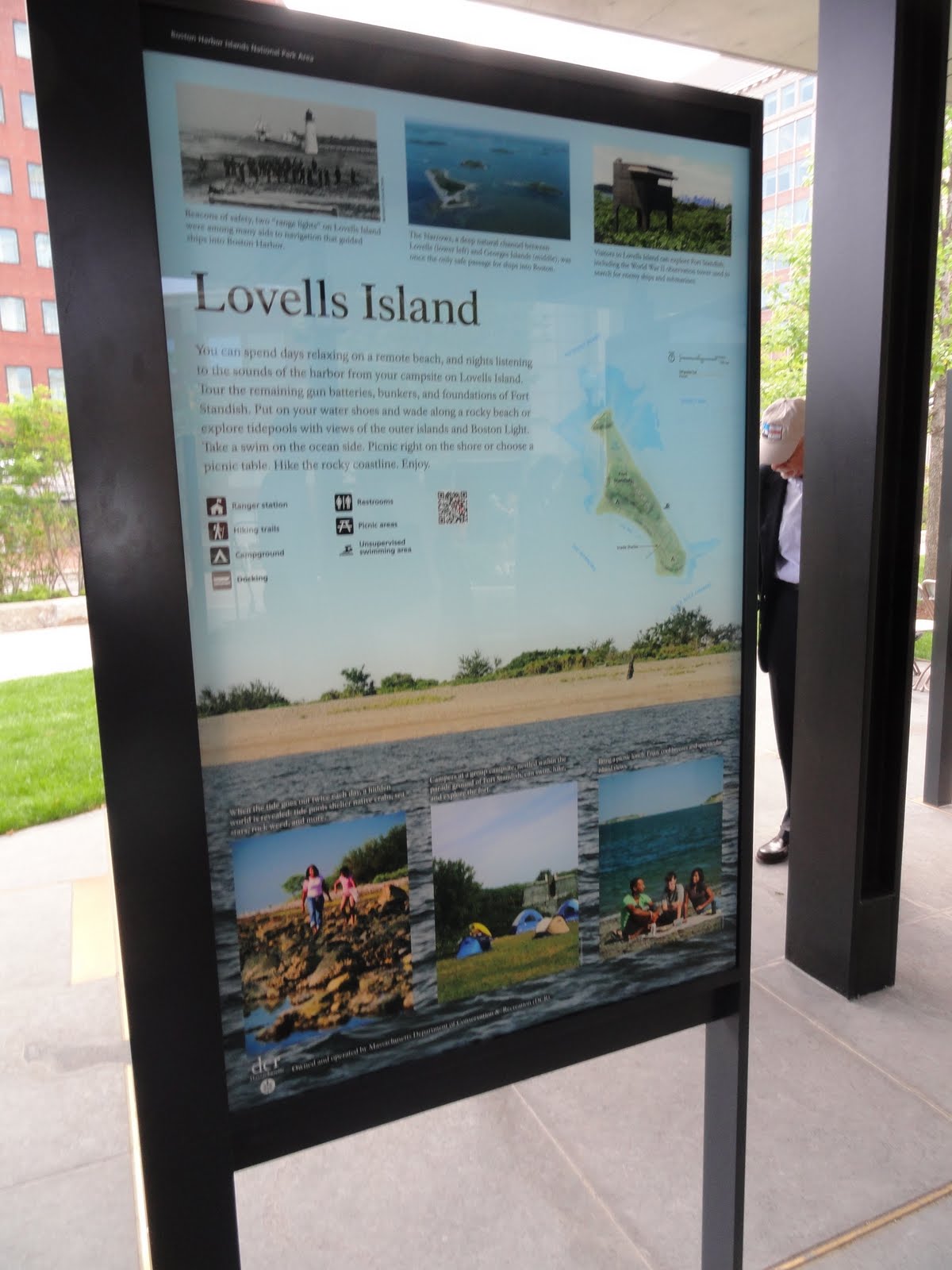
My first impression is that the Island Alliance, National Park Service, and all involved in the painstaking project did a tremendous job. The pavilion was much larger than I expected. It features self-serve kiosks where you can buy ferry tickets to the islands and large panels that profile the eight islands served by public ferries. The panels give brief rundowns on the islands' historical and recreational offerings on one side, and on the other they feature beautiful photography. Look down and you'll literally find yourself wandering the islands on a 2,000-square-foot topographical map of the park inlaid in granite. Rangers will be on hand during extended business hours to answer any questions.

Lovers of the islands already know what they have to offer, but for most visitors to the city--and probably the majority of its residents as well--the islands have been "out of sight, out of mind." Since this pavilion is in a very high traffic area between Quincy Market and the Marriott Long Wharf, it's going to catch the eye of thousands of people every day. No doubt the visibility of the Boston Harbor Islands national park area is going to get a big boost.

The pavilion is the first building to open on the Rose Kennedy Greenway. While you can't see any of the islands directly from the pavilion since it's a few hundred yards from the water, the Greenway is still a fitting location. The Greenway has reconnected downtown with its historic waterfront, and the pavilion will serve to further the connection between Boston and the harbor that gave birth to this city. Plus, the Big Dig project was responsible for the redevelopment of Spectacle Island, as fill from the harbor tunnel was used to resculpt the island into a vast recreational area.

If you swing by the pavilion, be sure to check out the gift shop. They have some pretty cool Civil War memorabilia (Fort Warren on Georges Island is one of New England's most historic sites connected to the war), postcards, and books on the islands. Not surprisingly, I encourage you to pick up a copy of Discovering the Boston Harbor Islands at the pavilion.

Wednesday, June 1, 2011

Globe Corner Bookstore Closing Its Doors

I've sung the praises of the Globe Corner Bookstore in Harvard Square on numerous occasions. It's a great travel bookstore and a local institution. Step inside and in just a few square feet you can travel the world. Sorry to hear the news then that the Globe Corner Bookstore is going to be closing its retail store, although it will live on online. The bookstore was put up for a sale a number of months ago and an acceptable buyer was not able to be found. The announcement came on the same day that Alex Beam of The Boston Globe wrote of the difficult times facing bookstores. Sickeningly prophetic.

Wednesday, May 25, 2011

Book Review: The Big Scrum


Last November I wrote an article for The Boston Globe taking a look back at the crisis that faced football in the early 1900s because of the violent nature of the sport (19 players died as a result of gridiron injuries in 1905) and Teddy Roosevelt’s intervention in 1905 to get the leading colleges to reform the sport. It had been suggested to me that the subject would make a good book. The primary source material about TR’s role seemed thin to me, though, and I wasn’t sure how such a book could be structured.

Well, now I see how the project could have been executed. John J. Miller delves into this particularly timely topic, given the current spotlight on hard hits and concussions in the NFL, in his new book, “The Big Scrum: How Teddy Roosevelt Saved Football.” Given the limited research materials on Roosevelt's actions in 1905, Miller’s work encompasses a broader timespan, taking a dual storyline of the evolution of football from its early days and the sporting life of Roosevelt from his days as a sickly youth.

Miller mentions early in “The Big Scrum” that he was surprised that the epic biographies of Roosevelt by Edmund Morris omitted any mention of his role in lobbying for college football reform, and I was as well when I was researching the subject. The book’s subtitle, “How Teddy Roosevelt Saved Football,” however, is probably a bit of hyperbole. Miller himself writes this about Roosevelt on page 17, “It is probably too much to call him football’s savior.”

Still, as a TR buff and a football fan, “The Big Scrum” was an informative and entertaining read, and I definitely learned some new factoids.

"The Big Scrum" reaffirmed my belief that Roosevelt could not have been a mere mortal (Could anyone else have given a 90-minute speech after being shot in the chest?). President, author of 18 books, big game hunter, trust buster, Rough Rider. Did this guy ever sleep? From Miller’s book I learned that one day a young TR rowed across Long Island Sound from Oyster Bay, NY, on a 25-mile roundtrip. During his honeymoon, he scaled the Matterhorn. Screw the Dos Equis guy; Teddy Roosevelt is “the most interesting man in the world.”

Even though many say that football is our “new national pastime,” the history of the early days of football hasn’t gotten nearly as much ink as that of baseball. “The Big Scrum” helps to fill that void, and this may be the most engaging part of the book. Miller takes us all the way back to Medieval Europe, whole towns would play a form of football where large mobs played with an inflated pig’s bladder. Hence the term “pigskin.” The tradition continues at the Royal Shrovetide Football Match. Augusta National this is not, however, if you check out the YouTube video. The story of the 1876 Harvard-Yale game, which opens the book, with Roosevelt in the stands as a spectator is a cracker. Yale won 1-0. Touchdowns did not count for points; only the kicks after touchdowns counted if they cleared a clothesline strung between two poles 20 feet apart from 100 feet away.

The evolution of rules is fascinating as well. One season safeties did not count against teams. As Miller writes, “A safety mere let [the offensive team] put the ball on their own 25-yard line and start over.” In the 1880 Princeton-Yale game, Princeton took the ball in the second half, took 11 safeties, and never gave Yale the ball. Result: a 0-0 tie. Fun! Makes Ravens-Steelers seem like an AFL shootout in comparison.

One other fun factoid: the first Cal-Stanford game in 1892 was delayed for an hour because no one remembered to bring a football. Perhaps the Stanford band entertained the crowd in the meantime.

Stay thirsty my friends...

Monday, May 23, 2011

Click: Historic Boston Harbor Islands Photographs

One of the great things about the Internet for any history buff is the ability to access photographs and historical resources that were once buried deep inside archives and libraries. Case in point are the fantastic vintage photographs that the Boston Public Library posts on Flickr. The recent release of baseball photographs taken by Leslie Jones received considerable press, and deservedly so. (Check out this incredible shot of a Cubs player sliding into home at Braves Field.) But I was just as excited to see the recently posted vintage photographs of the Boston Harbor Islands.

Check out this photograph taken on Long Island sometime around 1930. It shows the contestants of the annual baby crib race down Long Island Head at the starting line. Gentlemen, start your cradles!

OK, just kidding. It's a photograph of some of the children who were being cared for at Long Island Hospital along with some of the nurses out getting some fresh air.

The cool breezes and the open air of the islands were thought to have salubrious properties. Thus, the Boston Harbor Islands were a place of healing for generations of sick children from Boston. In addition to the hospital on Long Island, the Burrage Hospital on Bumpkin Island provided care and treatment for poor children with physical disabilities between 1902 and the start of World War I. And if you've always been confused as to why the Floating Hospital for Children at Tufts Medical Center is fully landlocked, well, it's because that it dates back to the days when it actually did sail on Boston Harbor. For 33 years starting in 1894, the Floating Hospital sailed the harbor so that its patients could benefit from its supposedly healing breezes.

(Photo courtesy of Boston Public Library)